
Picture a man and a woman who both develop diabetes in their 60s. Does the condition put their brains at equal risk? The answer may be “no,” according to two studies published in the last year. Both examined well-known dementia risk factors, such as high blood pressure, depression, and hearing loss. Both found that these risks don’t play out the same way in women and men. Yet the two studies point in somewhat different directions. Together, they suggest that one-size-fits-all prevention advice may miss important differences between the sexes.
Why researchers are comparing women and men
About 7 million adults in the United States live with Alzheimer’s disease, and nearly two-thirds are women. According to a 2015 study, a U.S. woman’s lifetime risk of Alzheimer’s dementia is about 20%. For a man, it’s about 10%. Women live longer on average, but longevity alone doesn’t fully explain the gap. Not every study finds that women develop dementia at higher rates, though. That suggests the difference may depend on age and on which group of people researchers study.
Meanwhile, scientists have grown more confident that many cases of dementia may be preventable. In 2024, the Lancet Commission on dementia prevention, intervention, and care named 14 modifiable risk factors. These are health conditions and habits that people can potentially change. They include physical inactivity, smoking, high blood pressure, diabetes, depression, hearing loss, and social isolation. The commission estimated that addressing all 14 factors could prevent or delay about 45% of dementia cases worldwide. (We covered that report in our article on how targeting 14 risk factors could cut dementia cases by nearly half.)
Most research on these risk factors doesn’t compare women and men directly. Instead, studies usually “adjust” for sex in their statistics. That approach assumes a risk factor affects both sexes equally, but this assumption may not hold.
Researchers are now considering differences in risk factors and their effects on the brain in men and women separately. The two studies tackle these questions using very different groups of people and different methods.
A national snapshot of who carries which risks
A study led by researchers at the University of California San Diego appeared in May 2026 in Biology of Sex Differences. Megan Fitzhugh and Judy Pa analyzed existing data from the Health and Retirement Study. That long-running survey aims to represent U.S. adults in midlife and later life. The researchers used information collected in 2008 from 17,182 people aged 40 and older. Their average age was 69, and 59% were women.
The team examined 13 risk factors. Twelve came from the Lancet Commission’s list. The researchers also added poor sleep, which the commission has flagged as a possible risk factor but not yet included in its estimates. The dataset lacked information on the other two commission factors, head injury and air pollution.
The researchers expected men to carry more of these risk factors. The data showed the opposite. Ten of the 13 risk factors differed in how common they were between the sexes, and women had more of them.
Some of these gaps are large, like the near doubling of depression in women. Others, like the few percentage points separating women and men on diabetes, are small. And prevalence tells only half the story. As the researchers stress, a risk factor that is common isn’t necessarily the one that does the most damage.
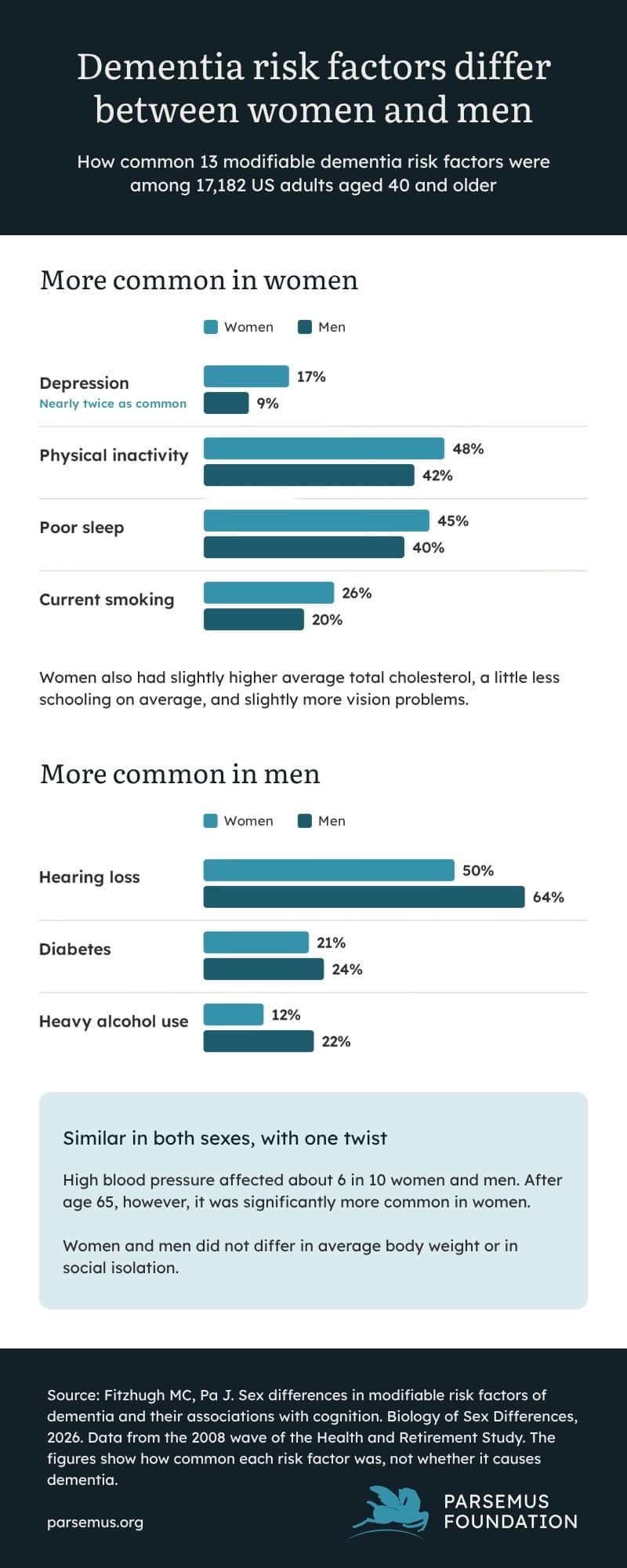
Risk factors have a larger effect on women’s memory
Fitzhugh and Pa next asked how each risk factor related to thinking skills. Participants took a short test of memory and mental focus, scored from 0 to 27. It involved recalling a list of 10 words, subtracting 7s in a row, and counting backward from 20.
The researchers linked several risk factors to larger drops in women’s scores than in men’s. Those factors were diabetes, hearing loss, and high blood pressure.
Body weight told an age-dependent story. Among people in their 50s and 60s, a higher body mass index (a measure of weight relative to height) went along with lower scores in women. In men of the same ages, it went along with slightly higher scores. By age 75, that difference between the sexes had disappeared.
The researchers also counted how many risk factors each person had. They linked each additional risk factor to a steeper drop in scores for women than for men.
Not every finding fits neatly. More years of education went with better scores in both sexes, and the link was a bit stronger in women. Oddly, higher total cholesterol also went with slightly better scores in women, but not in men. That runs counter to cholesterol’s usual role as a risk factor, and the study doesn’t resolve it.
On a 27-point test, differences of one or two points are modest for any individual. But the pattern held across several conditions. “Looking beyond which risk factors are most common, we found that some have a disproportionately larger impact on women’s cognition,” Fitzhugh said in a UC San Diego news release. Hearing loss is a telling example. It’s more common in men, yet the researchers linked it to a bigger hit to women’s scores.

A different picture from people in their 80s
An earlier study, published in 2025 in Alzheimer’s & Dementia, took a different approach. Jissa Martin and colleagues at the University of Queensland in Australia used data from the Rush Memory and Aging Project. That study has followed older adults in northeastern Illinois since 1997, with detailed clinical exams every year.
The analysis included 1,996 people aged 50 or older who didn’t have dementia when they joined. Their average age was nearly 80, and about three-quarters were women. Some started with normal thinking skills. Others had mild cognitive impairment, a stage of noticeable memory or thinking problems that doesn’t yet interfere much with daily life. Over the follow-up period, 580 participants developed dementia.
This team estimated how many dementia cases might be preventable, using a measure called the population attributable fraction. It estimates the share of dementia cases that might not have happened if a risk factor had been eliminated entirely. That’s a theoretical ceiling, not a prediction of what lifestyle changes would achieve.
For the group as a whole, the researchers estimated that about 22% of dementia cases were potentially preventable. That figure assumes the relevant risk factors could be eliminated. But women have much less potential than men do for preventing dementia by eliminating risk factors. Among men, the estimate was about 43%; among women, it was about 19%.
The difference was sharpest in people who already had mild cognitive impairment. There, the estimate was about 52% for men, compared with about 12% for women. The lower share of preventable cases among older women, they write, suggests prevention “may need to be targeted at an earlier stage of life” for women. They call for studies of younger people, because midlife risk factors may offer more relevant insights, particularly for women.
The risk factors that mattered also differed. In men, smoking was the single biggest contributor. Physical inactivity also stood out among men with mild cognitive impairment. In women with normal thinking skills at the start, two factors — depression and social isolation — showed significant links to later dementia. The authors describe this as a lifestyle-driven profile in men and a psychosocial one in women.
Overall preventability was similar before and after mild cognitive impairment set in. That suggests risk reduction may still help once memory problems begin.
What these studies can’t tell us
The Australian team points to one notable gap. Their analysis didn’t include female-specific factors such as menopause, reproductive history, or hormone therapy. Neither did the UC San Diego study. Yet emerging research links these factors to brain changes and memory decline in women, the Australian authors note. See our article on the use of hormone replacement therapy (HRT) to address mental well-being in women, and our article on how HRT, menopause timing, and brain health intersect.
A retrospective study in the Archives of Women’s Mental Health evaluated 510 menopausal women using transdermal testosterone therapy for 4 months and found a 39% improvement in cognition (among other improvements). See our article here.
What this means for preventing dementia
Despite their differences, the studies point to a common possibility: dementia risk factors may not carry the same weight for everyone. Sex appears to be one important source of that variation. “Sex differences are profoundly overlooked among many leading causes of death like Alzheimer’s, heart disease and cancer,” Pa said in the news release.
For women, a handful of factors stand out across the two studies. Researchers tied hearing loss, diabetes, and high blood pressure to bigger drops in women’s thinking scores than in men’s. Excess weight mattered too, especially among women in their 50s and 60s. Depression was nearly twice as common in women. The Illinois study also linked depression and social isolation to later dementia among women. Women also had poorer sleep and more physical inactivity. Future studies will need to report results separately for women and men. They will also need to include factors like menopause and hormone therapy. As they do, our understanding of dementia risk factors should greatly improve.
In the meantime, none of this changes the basic message about modifiable dementia risk factors. Treating high blood pressure and diabetes, addressing hearing loss, staying active, not smoking, and getting help for depression are all worthwhile for both sexes. This research suggests that for women, some of these steps may deserve extra attention, and perhaps earlier.
“Ultimately, a more nuanced understanding of these differences could help us design smarter, more targeted interventions,” Fitzhugh said. She called that “an essential step toward reducing the burden of dementia for everyone, but especially for women, who are disproportionately affected.”
See our web page and other news articles about dementia and Alzheimer’s disease prevention.