
Key points
- Testosterone is the most abundant active sex hormone in women, and levels fall steadily with age. Doctors have prescribed testosterone to women for menopausal symptoms for years, but scientific evaluation is limited.
- A new 2026 review finds that using testosterone for low sexual desire has the strongest evidence base, but evidence for other benefits is weaker.
- Testosterone applied to the skin has the best trial evidence. Pellets often push levels above the normal female range.
- The US has never approved a testosterone product for women. But in September 2026, the FDA signaled openness to approving testosterone for women. Public comments on this topic are open until October 19, 2026.
Human health news
For more information on the use of testosterone for menopause hormone therapy, see our Hormones for Menopause project.
Testosterone is not just a male hormone
When people hear “menopause hormone therapy,” they usually think of estrogen. Estrogen, often paired with a progestogen to protect the uterus, eases hot flashes, night sweats, and vaginal dryness. The FDA has approved many estrogen products for these symptoms. But estrogen is only part of a woman’s hormone story.
Testosterone is often called a “male” hormone. Yet it’s the most abundant active sex hormone in women’s bodies. Young ovaries make three to four times more testosterone than estrogen. The adrenal glands and other tissues make it too. Testosterone acts on androgen receptors found in the brain, heart, blood vessels, bones, muscles, breasts, skin, bladder, and vagina.
Testosterone therapy for menopausal women
Women’s testosterone falls steadily with age, not suddenly at menopause. By 40, the average woman has about half the testosterone she had at 21. Surgical removal of the ovaries causes a much sharper drop. Doctors have linked low testosterone to low sexual desire, persistent fatigue, low mood, and hot flashes.
Doctors have given testosterone to women for nearly a century. Pellets implanted under the skin date back to the 1930s. In the 1940s, physicians used testosterone for fibroids, breast cancer, and low libido, and noticed that patients reported feeling better overall. Some countries, including Australia, have long allowed testosterone treatment for women.
The United States took a different path. In 2004, the FDA declined to approve a 300-microgram testosterone patch for women with low sexual desire. The agency cited uncertain benefits and too little long-term safety data, even though two years of trial data looked reassuring. More than 20 years later, American women still have no FDA-approved testosterone product. Men, by contrast, can choose from more than 30!
A new review published in April 2026 in Cureus takes stock of what we know. Four obstetrician-gynecologists at Florida International University examined testosterone’s role in women, its benefits and risks, and the ways to deliver it. It’s a narrative review, meaning the authors selected and summarized studies rather than following a formal systematic protocol. The authors have a clear goal: they urge the FDA to fund long-term trials and move toward approving a testosterone product for women. The authors’ summary is “Women deserve access to regulated, effective treatments grounded in scientific evidence.”
“Women deserve access to regulated, effective treatments grounded in scientific evidence.”
The benefits: strongest evidence for sexual desire
The best-supported use of testosterone in women is hypoactive sexual desire disorder, or HSDD. HSDD means a loss of sexual interest that causes a woman real distress. It affects about 1 in 10 women. It’s more common after surgical menopause (16–26%) than in premenopausal women (7–14%).
The strongest evidence for the use of testosterone on HSDD comes from a 2019 meta-analysis that pooled 36 randomized controlled trials with 8,480 women. The analysis found that testosterone applied through the skin meaningfully improved desire and sexual satisfaction in women with HSDD. This is the only use that major medical societies currently endorse.
The 2026 review argues that testosterone may help with more than sex drive. In a 2011 study using pellet implants, women reported better mood, energy, sleep, and bladder and vaginal symptoms on a standard menopause rating scale. Other reports suggest possible gains in muscle mass, cholesterol and other metabolic markers, and even scalp hair. But these studies were mostly observational, so they cannot prove that testosterone caused the improvements.
Before prescribing, a clinician should also rule out other causes of low desire. These include relationship problems, depression, medications, anemia, and vaginal dryness or pain from genitourinary syndrome of menopause.
The risks: mostly mild, but long-term data are thin
The review concludes that testosterone, used at appropriate doses, has a reassuring safety record. However, no randomized trial of testosterone for menopause in women has lasted more than two years. So, we lack the long-term trial data that would settle questions about cancer and heart disease.
- Common side effects. Acne and unwanted hair growth on the face or body are the most frequent problems, especially at high doses. Both usually fade as the dose decreases.
- Rare but lasting effects. Higher doses can occasionally cause clitoral enlargement or a deeper voice. These are uncommon, but they may not reverse after stopping treatment.
- Hair loss. The evidence the review cites suggests this is not a consistent problem at usual doses. Some women with thinning hair even report regrowth.
- Breast cancer. Short-term trials and systematic reviews of skin-applied testosterone at normal female levels have not found higher breast cancer risk. Learn more about research on hormones after breast cancer.
- Uterine cancer. Unlike estrogen, testosterone given alone does not thicken the uterine lining. Women using only testosterone do not need a progestogen for uterine protection from cancer.
- Heart and blood vessels. Testosterone taken by mouth raises “bad” LDL cholesterol and lowers “good” HDL cholesterol, so experts advise against it. Testosterone through the skin (transdermal), by contrast, has not raised blood pressure, blood sugar, or the risk of blood clots in trials. But those trials mostly excluded women at high risk of heart disease, so caution is advised.
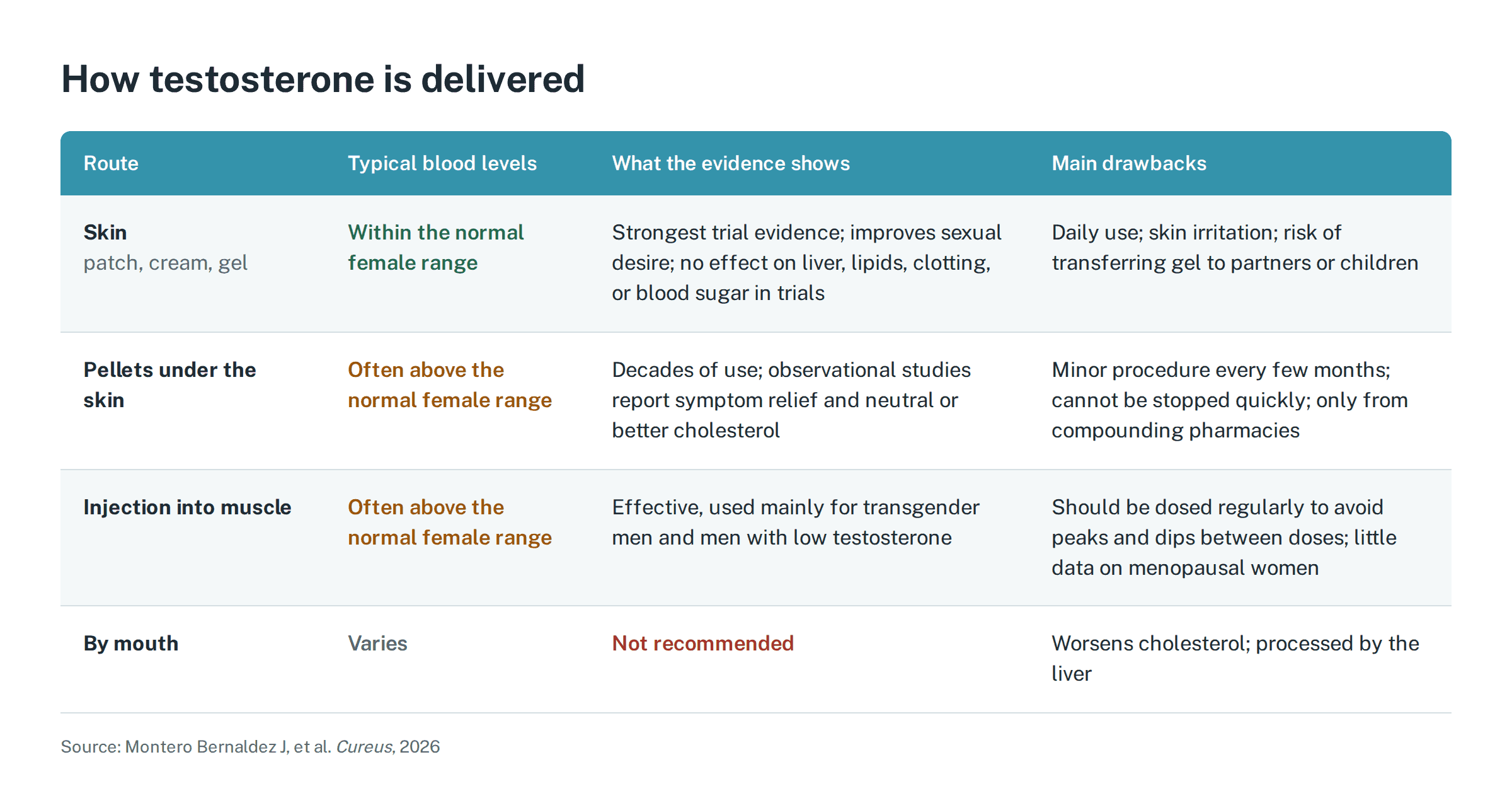
How testosterone is delivered
How testosterone enters the body matters as much as the dose. Each route has trade-offs, and the review notes that trials have not shown one method is clearly best.
The dose debate
The sharpest disagreement in this field concerns how much testosterone women should get. The 2019 Global Consensus Position Statement on testosterone for women, backed by major medical societies, advises keeping levels within the normal female range. It recommends against pellets and injections that push levels higher.
The review’s authors push back. They cite studies suggesting that “physiological” doses may be too low for some women. In those studies, women with higher testosterone levels reported larger improvements, and heavier women needed higher doses. The authors favor adjusting doses by symptoms and response, not lab numbers alone.
The missing product problem in the US
The biggest barrier to safe testosterone use for American women isn’t the science. It’s the lack of an approved product. Testosterone for postmenopausal women with low desire is approved in Australia, New Zealand, the United Kingdom, and South Africa. In the US, no product is approved, so every prescription is a workaround.
Some doctors prescribe a small fraction of a testosterone gel approved for men, which is hard to measure accurately. Many women turn to compounding pharmacies for creams, gels, or pellets instead. Compounded products skip FDA review, so strength can vary from batch to batch. There’s no good system for reporting their side effects, insurance rarely covers them, and pellets often push levels above the normal female range. Meanwhile, off-label prescribing for women around menopause has roughly tripled in five years, much of it through “wellness” clinics.
A rare opening at the FDA
There is some good news. On September 17, 2026, the FDA held a public workshop on testosterone use in menopausal women. The agency said it “stands ready” to work with drug companies and wants to bring approved products to American women. It also signaled it may be able to draw on data from countries that already approve testosterone for women.
The FDA’s top concerns are heart disease, breast cancer, and safety beyond two years. Those are the same gaps the review’s authors want long-term trials to fill. The authors also call for standardized dosing and approved products designed for women.
You can weigh in. The FDA is accepting public comments on testosterone for menopausal women until October 19, 2026. Comments go to docket FDA-2026-N-5479 at Regulations.gov. Women’s experiences, good and bad, can help shape the agency’s next steps.
What women considering testosterone for menopause should know
Testosterone is a real option for some women, but it’s not a cure-all. If you’re thinking about it, keep these points in mind:
- Know what it’s proven for. The best evidence supports testosterone for low sexual desire that causes distress, especially after menopause. Claims about energy, mood, memory, muscle, and weight rest on weaker evidence.
- Rule out other causes first. Relationship stress, depression, medications, anemia, and vaginal pain can all lower desire. Estrogen, including vaginal estrogen, may help some symptoms on its own.
- Start low and stay in range. Skin-applied products keep levels within the normal female range and are easiest to adjust or stop. Pellets can push levels high and can’t be stopped quickly.
- Ask about quality and watch for side effects. If you use a compounded product, ask where it comes from and how its strength is checked. Report acne, new facial hair, or voice changes promptly.
- Share your history and reassess. Tell your clinician about any breast cancer, heart disease, stroke, diabetes, or blood clots. If nothing improves after about six months, guidelines suggest stopping.
Testosterone for women has a long history, a growing evidence base, and a regulatory system that has not caught up in the US. Longer trials and an approved product would give women what they deserve: clear answers and reliable treatment.
To learn more about testosterone and other hormone options for menopause, visit our Hormones for Menopause page.