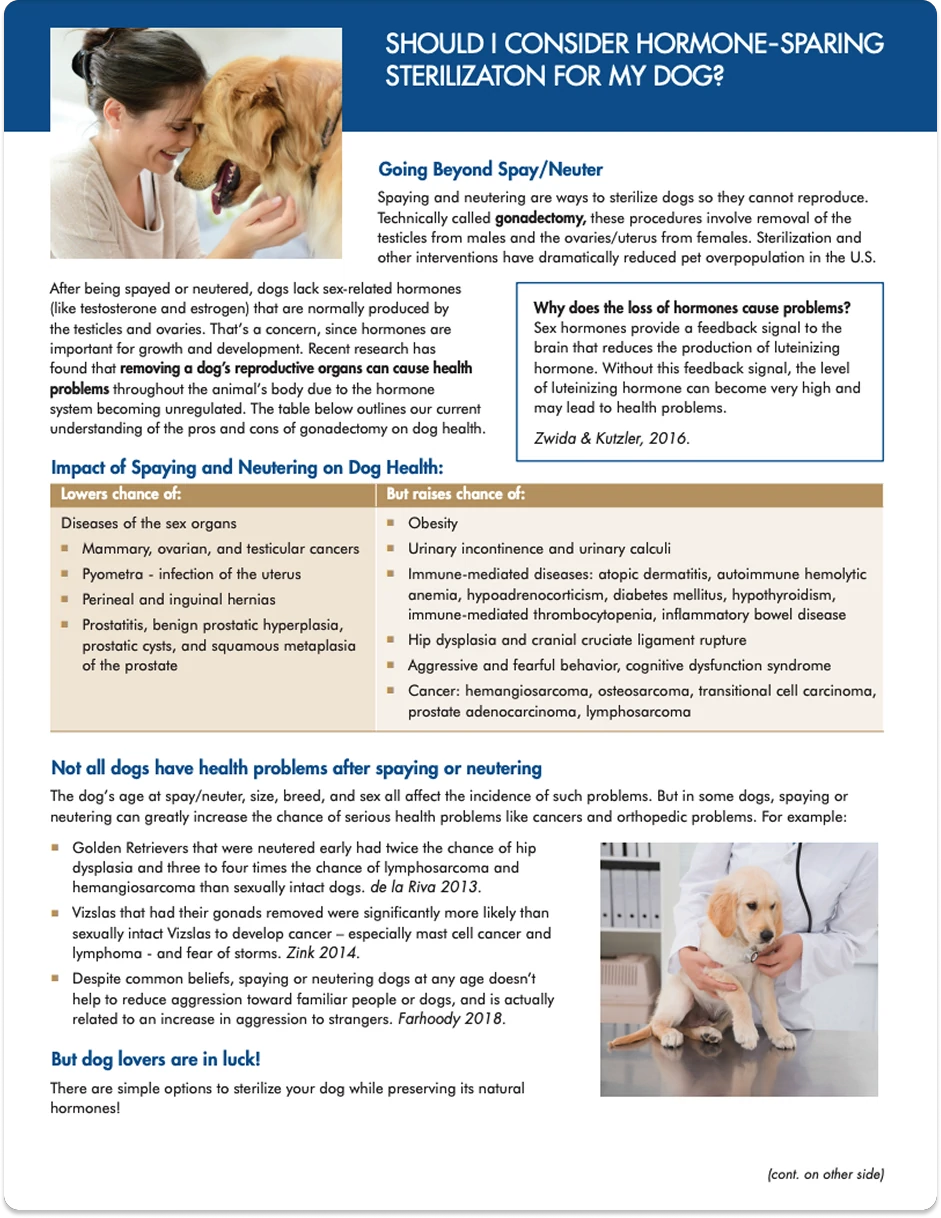
Proper identification of dogs who have received hormone-sparing sterilization is critical to avoiding unnecessary repeat surgeries. Find out what you need to know about identifying dogs that have received a hysterectomy or vasctomy by applying a simple tattoo.

Use our Veterinarian Directory to find a veterinarian near you who offers hormone-sparing sterilization.

Background

  • Hormone-sparing sterilization methods ensure population control while guarding the lifetime well-being of dogs.
  • Increasing numbers of dogs have received hormone-sparing sterilization to avoid the negative impacts from hormone loss. But hormone sparing methods may not be obvious.
  • To ensure that lost or rehomed dogs do not receive a repeat surgery, it is important to use standard identification of dogs that had a hysterectomy or vasectomy.

Key points

  • To identify dogs that have been sterilized by hormone-sparing procedures, a simple tatoo can be applied.
    • Hysterectomy tattoo — green “X”
    • Vasectomy tattoo — green “V”
  • The simplicity of the marks does not require dedicated tattoo equipment or special skill, so that most veterinarians could provide the identification.

Parsemus' role

  • The Parsemus Foundation has funded work on identification of free-roaming dogs in the past, and supports idenfication of owned dogs with simple tattoos that can be easily applied and read.
The Project in Detail

Hormone-sparing sterilization methods ensure population control while guarding the lifetime well-being of dogs. Hysterectomy (also called ovary-sparing spay) for females and vasectomy for males are ways to sterilize pets without the negative impacts from hormone loss. For a recent overview on the health implications of traditional spay and neuter, and a review of hormone-preserving contraceptive options, see this article in the Innovative Veterinary Care journal.

Pet owners can find veterinarians in your area offering ovary-sparing spay as an option. Veterinarians can review information on canine hysterectomy and vasectomy and register their veterinary clinic in the free directory to connect with clients. Also, visit the Facebook Ovary Sparing Spay and Vasectomy Group for a list of veterinarians who offer alternatives to traditional spay and neuter and to share your experiences.

Knowing whether a dog was sterilized is critical for preventing unnecessary repeat surgeries. However, lack of standardization has been a barrier. After a review of common identification methods for owned dogs and methods being used currently by veterinarians, a simple tattoo in the inguinal area is recommended as the standard for hormone-preserving sterilization methods:

Hysterectomy: Green “X” slightly lateral to midline near umbilicus
Vasectomy: Green “V” lateral and cranial to scrotal region

The simplicity of the marks does not require dedicated tattoo equipment or special skill, so that most veterinarians could provide the identification. Tattoos can be created using a needle or scalpel to apply the tattoo ink to the dermis. This video illustrates the technique. The procedure is completed while the dog is sedated for a sterilization procedure  and no additional equipment is needed for detection. Although clarity of a tattoo may decrease over time, in this case it is not necessary that it is legible — just that it’s visible.

For Veterinarians

  • Veterinarians who wish to be listed in the directory may do so by filling out the info on the clinic registration form.
  • Use this flyer as an informational piece for your website or as a handout for clients.
  • Email us at  if you would like to consult with a veterinarian who is experienced with hormone-sparing sterilization.
  • Review the Additional Resources below. Take note of the information about gonadectomy risks for specific breeds and mixed-breed dogs published by Hart and colleagues (2020) and stay abreast of recent updates in this rapidly evolving area of research.
Add your clinic to our Vet Directory

For Pet Owners

  • Review this flyer to understand whether hormone-sparing sterilization is right for you and your dog. Keep in mind that impacts vary on breed, size and other factors. Check the recent publications about cancer and joint disorders by dog breed and mixed-breed size.
  • Consult with a veterinarian who is familiar with the health issues related to spay/neuter and familiar with hormone-sparing options. Each dog and family is different, and having an expert consultation on the best method of sterilizing your dog is important.
  • To find a provider you can search the Veterinary Directory or check the information at the Ovary Sparing Spay and Vasectomy Info Facebook Group. If you cannot find a provider nearby, you could pass along the information on this website to your own veterinarian and ask if he or she can provide the procedure. Direct him or her to the information on this website and email us at  if additional assistance/advice is required.
  • Please let us know if you find a veterinarian who offers OSS or vasectomy and would like to join our directory!
  • If you choose to preserve your dog’s hormones, consider joining this Facebook group: Training and behavioral advice for Intact Dogs.

For Pet Owners

Looking for a veterinarian willing to perform procedures beyond surgical spay or neuter? Browse our directory of qualified veterinary professionals.

Search for a Veterinarian

Do you offer alternative methods of contraception like ovary-sparing spay and vasectomy? Join our referral directory so new clients can find you.

Add your clinic to our Vet Directory

Scientific publications

See our searchable bibliography for a complete library of scientific publications on our projects.

Key publications on identification of dogs receiving HSS:

How Spay/Neuter Affects Health

Q: Why is “traditional” spaying and neutering being questioned now?

A: For decades, removing the gonads (ovaries/testes) was the standard for population control. However, research shows that these organs do more than just reproduce; they produce hormones (estrogen, progesterone, and testosterone) that are essential for development, bone density, muscle mass, and immune function. Removing them—especially in young dogs—can increase the risk of hip dysplasia, cruciate ligament tears, obesity, urinary incontinence, diabetes, and certain cancers like osteosarcoma or hemangiosarcoma.

Q: What are the pros and cons of traditional spay/neuter?

A: Deciding to remove a dog’s reproductive organs is a trade-off. It effectively sterilizes the dog, but while it eliminates certain risks, it increases others.

  • Pros (Benefits of removal): Eliminates the risk of diseases of the ovaries and testicles and those influenced by sex hormones. This includes pyometra, uterine/ovarian cancer, mammary tumors, and testicular cancer.
  • Cons (Risks of hormone loss): Increases the risk of several serious “non-reproductive” diseases. These include orthopedic issues (CCL tears, hip dysplasia), certain aggressive cancers (hemangiosarcoma, osteosarcoma, mast cell tumors), and metabolic or urinary issues (obesity, urinary incontinence in females).

Q: Which diseases become more common after a dog is spayed or neutered?

A: Research indicates that when a dog is deprived of sex hormones during development or throughout adulthood, the following conditions are more frequently observed:

  • Joint Disorders: Hip dysplasia and cranial cruciate ligament (CCL) tears (often due to the “delayed closure” of growth plates, leading to longer, weaker limbs).
  • Cancers: Lymphoma, Hemangiosarcoma (cancer of the blood vessels), and Osteosarcoma (bone cancer).
  • Behavioral/Other: Increased anxiety, noise phobias, obesity, and urinary incontinence.

Q: Why are some health problems more common in spayed and neutered dogs?

A: Without the sex hormones produced by the ovaries and testicles, the entire system becomes unbalanced. Normally, the hypothalamus and pituitary glands in the brain stimulate the production of luteinizing hormone (LH) and follicle stimulating hormone (FSH). The LH surge then stimulates the production of steroid hormones (like estrogen, progesterone or testosterone) from the gonads. Without the ovaries or testes, there is no feedback signal to the brain to reduce production, so LH continues to be over-produced. Diverse health problems likely result from the loss of sex hormones and the high LH levels.

Q: Is the only alternative to keep my dog “intact”?

A: No. Many owners worry that the only way to keep their dog healthy is to leave them fully intact, which carries the risk of accidental litters. Hormone-sparing sterilization (such as vasectomy or ovary-sparing spay/hysterectomy) offers a “middle ground.” These procedures make the dog 100% sterile (unable to reproduce) while allowing them to keep their natural hormones and the health protections they provide.

Q: Is there a “best age” to spay or neuter?

A: There is no single “correct” age for all dogs. The ideal timing depends heavily on the dog’s breed, sex, and lifestyle. For example, a Great Dane may need to remain intact longer to allow their joints to fully develop, whereas a small breed may have fewer risks associated with early sterilization. This is why an individualized approach is essential.

Q: Does my dog’s breed affect when (or if) they should be neutered?

A: Yes, significantly. A landmark study of 35 different breeds showed that the “safe” age for sterilization varies wildly. For some breeds, neutering before one year of age significantly increases cancer and joint risks, while for others, the impact is minimal. Owners should consult breed-specific data before making a decision.

Q: How should I talk to my vet about this?

A: It is important to seek veterinary guidance from a professional who stays current on the latest research. You might ask: “Given my dog’s breed and health history, what are the specific risks of a traditional spay/neuter?” or “Are you familiar with hormone-sparing options like an Ovary-Sparing Spay or Vasectomy?” If your regular vet is not comfortable with these procedures, you can use the Parsemus Veterinary Directory to find a specialist who is.

Q: If I choose to spay or neuter my dog, does my dog’s age matter?

A: This study indicated the longer the dog had natural hormones, the more improved their health and behavior were. This applied to dogs that were left intact longer, dogs that had an ovary-sparing spay, and dogs that had a vasectomy.

Hormone-Sparing Procedures

Q: What is a Vasectomy for dogs?

A: Similar to the procedure in humans, a canine vasectomy cuts or blocks the vas deferens – the tube that carries sperm from the testicles out of the body. This makes the dog sterile (unable to reproduce) but allows him to keep his testicles and his natural testosterone. He will still be interested in “intact” females, but he cannot father puppies.

Q: What is an Ovary-Sparing Spay (OSS) or Hysterectomy?

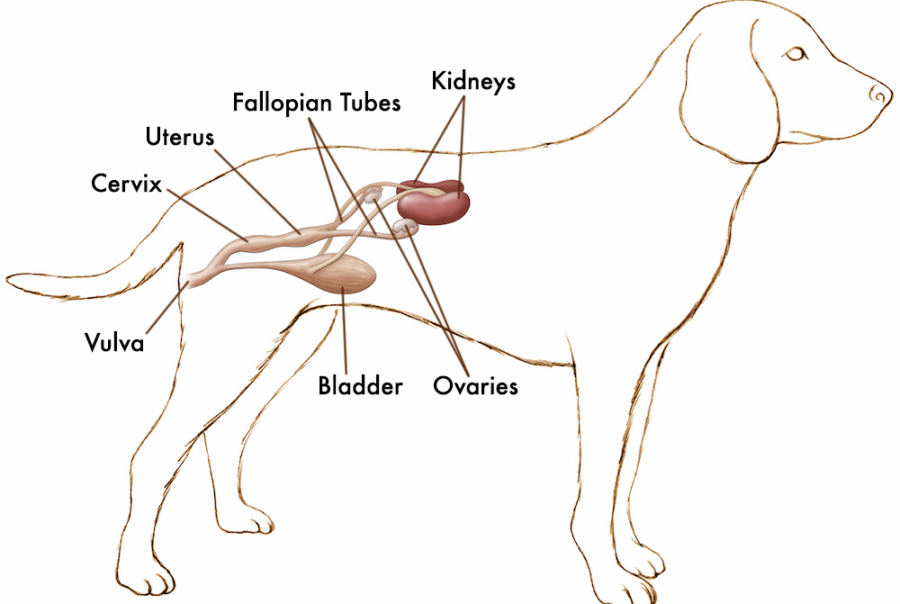
A: In an OSS, the surgeon removes the uterus and part of the cervix but leaves one or both ovaries intact. This prevents pregnancy and eliminates the risk of “pyometra” (a life-threatening uterine infection), but the dog continues to produce the hormones necessary for healthy aging.

Q: Will a dog with an Ovary-Sparing Spay still go into “heat”?

A: Yes. Because the ovaries remain, the dog will still experience hormonal cycles. She may attract males and exhibit some behavioral changes associated with heat, but because the uterus is gone, she will not have a bloody discharge and cannot become pregnant.

Q: Will my dog’s behavior change after a hormone-sparing sterilization?

A: Hysterectomy or vasectomy will not change your dog’s behavior like traditional spaying and neutering. Because the dogs retain natural hormones, females will have a “dry” heat cycle and males may be interested in females in heat (although they cannot reproduce).

Q: Are these procedures harder to find?

A: Yes. Most veterinary schools still only teach the traditional spay/neuter procedure. However, the Parsemus Foundation maintains a searchable directory of veterinarians who are trained and willing to perform hormone-sparing procedures.

Q: Is a hormone-sparing spay more expensive?

A: It can be. Because it is a specialized procedure that requires more precision (to ensure all uterine tissue is removed while keeping ovaries safe), it may cost more than a high-volume, traditional spay. However, many owners view it as an investment in preventing future health costs and suffering.

Q: Where can I get ovary-sparing spay for my cat?

A: Ovary-sparing spay in cats is uncommon due to limited research on health impacts of gonadectomy in cats and intolerance towards behaviors associated with cat hormones (spraying, fighting, howling in heat). However, many veterinarians in our Veterinary Directory provide ovary-sparing spay in at least dogs so feel free to contact those veterinarians and inquire about ovary-sparing spay for your cat.

Q: Where can I get ovary-sparing spay for my dog?

A: The Parsemus Foundation’s Veterinary Directory lists specialists worldwide that can provide ovary-sparing spay procedures. In addition, you can discuss ovary-sparing spay with your regular veterinarian and share our page on Hormone-Sparing Sterilization Procedures with them. If you don’t find a veterinarian in your area, you may be able to find one by visiting the Ovary Sparing Spay and Vasectomy Info group on Facebook.

Identification of Sterilized Dogs

Q: Why is identification so important for these dogs?

A: If a dog with a hormone-sparing procedure ends up in a shelter, a vet might assume they are completely intact and perform a second, unnecessary surgery. Clear identification prevents “re-spaying” or “re-neutering” and ensures the dog’s unique hormonal status is understood by future medical providers.

Q: How can a vet tell if my dog was sterilized if they still have their gonads?

A: This is a major concern for owners of dogs with vasectomies or ovary-sparing spays. To an outside observer or a shelter, these dogs look “intact.” The Parsemus Foundation advocates for clear identification methods, such as a standardized tattoo on the abdomen (a small green “X” for hysterectomy or “V” for vasectomy). Adding specific notes in the dog’s microchip record will also be useful.

Last updated on September 10, 2026

“Based upon the review of the literature, it becomes clear that canine gonads are not merely reproductive organs but critical to endocrine, musculoskeletal, behavior, and antineoplastic health.”

Zwida & Kutzler

“Recent scientific studies demonstrate that spaying/neutering, particularly before a dog is fully mature, may result in detrimental long-term health impacts. In light of this information, AKC encourages breeders, owners and veterinarians to consult on the appropriateness and timing of spaying or neutering an individual dog.”

AKC Position Statement on Spaying and Neutering

“About the only positive effect on behavior that seems to result from spaying and neutering is the roughly 68 percent decrease in urine marking.”

Stanley Coren Ph.D., F.R.S.C

“Thought leaders are beginning to accept that spay and neuter have both positive and negative health consequences that vary by age, gender and breed.”

Elaine Lissner

“The societal practice in the U.S. of dog neutering contrasts with the general attitudes in many European countries, where neutering is commonly avoided and not generally promoted by animal health authorities.”

Torres de la Riva, et al.

“Laparoscopic ovariectomy in cats is safe, can be performed in a comparable amount of time as traditional ovariohysterectomy, and may result in less postoperative discomfort.”

Case et al.

“I am so thankful for this site. I have referred people to you for years. ... I've told people about the option of hormone-sparing surgeries and also managing their intact animals with integrity and compassion. I look at your site and tell them about veterinarians near them who can do these surgeries.”

Website Visitor

How useful was this content?

Click on a star to rate it!

Thank you for your rating!

Help us improve this content!

Is there anything we can improve? Include your email if you'd like a response.