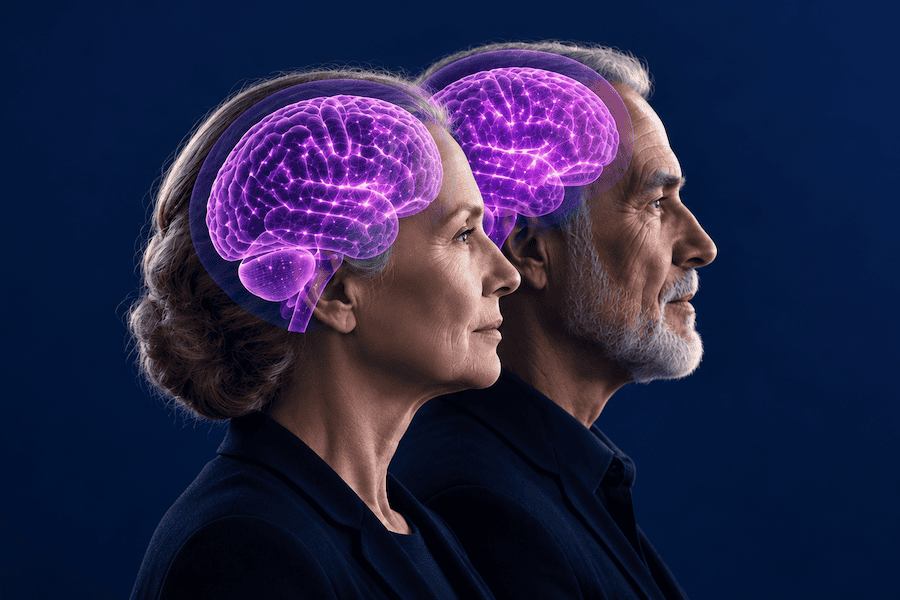
Alzheimer’s disease, hormones, and diet

Testosterone and fish oil (DHA) are promising supplements for reducing the risk of developing memory problems and Alzheimer’s disease. A clinical trial is underway to evaluate their influence on men with memory complaints by measuring the development of amyloid plaque in the brain — a hallmark of Alzheimer’s disease.

Background

  • There are various methods to reduce the risk of developing Alzheimer’s disease and dementia.
  • Supplements such as fish oil and the hormone testosterone have been considered as protective against Alzheimer’s.

Key points

  • Low testosterone levels have been related to memory problems.
  • Individuals with Alzheimer’s disease have lower DHA (omega-3 fatty acids found in fish oil).
  • A clinical trial on the use of testosterone and fish oil in men is underway to determine if there is any influence on cognitive decline.

Parsemus' role

  • The Parsemus Foundation provided early support for the clinical trial being conducted in Australia to evaluate fish oil and testosterone on the development of memory problems in men.
The Project in Detail

Testosterone levels in both men and women decline with age, and low testosterone levels have been related to memory problems. Studies have shown that low testosterone levels have preceded cognitive impairment and the neuropathology of Alzheimer’s. Testosterone is also the likely reason that women carrying the apolipoprotein E4 (APOE4) genotype have a much higher risk of developing Alzheimer’s compared to men. The relationship between testosterone replacement therapy in men and women has been harder to quantify due in part to the small number of long-term, controlled studies available.

Another factor critical to brain function is omega-3 fatty acids, including DHA and EPA which usually come from fish oil. In the brains of older people, there is a depletion of long chain omega-3 fatty acids, and those with Alzheimer’s disease have lower DHA levels. DHA supplements can reduce markers of inflammation, which may influence Alzheimer’s disease. In dietary intervention studies, supplementation with DHA and/or EPA seems to be more effective in improving cognition in early stages of cognitive impairment.

Research on the impact of testosterone and dietary supplements is complex and studies frequently report conflicting results.  This may be due to the many individual factors that can affect outcomes, brief follow up, different methods, and lack of comparable imaging data. Long-term randomized clinical trials are needed before conclusions can be made.

To help understand the influence of testosterone and fish oil for Alzheimer’s disease and memory, the Parsemus Foundation provided early support for a randomized controlled prospective trial on the impact of testosterone or DHA versus placebo on the onset of amyloid plaque associated with Alzheimer’s disease in men with memory complaints. The study is being conducted at Alzheimer’s Research Australia (formerly called the McCusker Alzheimer’s Research Foundation). Based on the results of a smaller non-placebo trial, the researchers led by Dr. Ralph Martins are optimistic that one or both treatments may slow the development of amyloid plaque and cognitive decline.

The trial has been screening men by completing a positron emission tomography (PET) amyloid scan prior to selection for the trial. The enrollment for the trial has ended in 2025 with participants undergoing completion of the study. In addition to the treatment arms, blood tests and retinal images from all participants will help to develop early diagnostic tests for Alzheimer’s disease.

Learn more about dementia and Alzheimer’s disease — and what you can do to lower your risk. There are many lifestyle changes that can reduce the chance of developing Alzheimer’s disease, such as diet, exercise, and appropriate supplements. See Additional Resources below.

Scientific publications

See our searchable bibliography for a complete library of scientific publications on our projects.

Key publications on testosterone and fish oil for Alzheimer’s:

  • Kaufman J-M, Lapauw B. (2020). Role of testosterone in cognition and mobility of aging men. Andrology 8:1567–1579. (Free full text).
  • Thota RN, Rosato JI, Burrows TL et al. (2020). Docosahexaenoic acid-rich fish oil supplementation reduces kinase associated with insulin resistance in overweight and obese midlife adults. Nutrients 12(6), 1612. (Free full text).
  • Vlachos GS, Scarmeas N. (2019). Dietary interventions in mild cognitive impairment and dementia. Dialogues Clin Neurosci 21(1):69-82. (Free full text).
  • Tan S, Sohrabi  HR, Weinborn M et al. (2019). Effects of testosterone supplementation on separate cognitive domains in cognitively healthy older men: A meta-analysis of current randomized clinical trials. Am J Geriatr Psychiatry  27(11):1232-1246. (Abstract)
  • Martins RN, Villemagne V, Sohrabi HR, et al. (2018). Alzheimer’s disease: A journey from amyloid peptides and oxidative stress, to biomarker technologies and disease prevention strategies-Gains from AIBL and DIAN cohort studies. J Alzheimers Dis. 62(3):965-992. (Free full text).
  • Asih PR, Tegg ML, Sohrabi H, Carruthers M, Gandy SE, Saad F, Verdile G, Ittner LM, Martins RN. (2017). Multiple mechanisms linking type 2 diabetes and Alzheimer’s disease: Testosterone as a modifier. J Alzheimers Dis. 59(2): 445–466. (Free full text).
  • Wahjoepramono EJ,  Asih PR, Aniwiyanti V et al. (2016). The effects of testosterone supplementation on cognitive functioning in older men. CNS Neurol Disord Drug Targets. 15(3): 337–343. (Free full text)
  • Thomas J, Thomas CJ, Radcliffe J, Itsiopoulos C. (2015). Omega-3 fatty acids in early prevention of inflammatory neurodegenerative disease: A focus on Alzheimer’s disease. Biomed Res Int. 2015:172801. (Free full text).

Last updated on October 13, 2026

“This was a very good article. Thank you for sharing this information.”

Anonymous

“It will be interesting to see what this discovery leads (to) after more tests. (...) It sounds promising!”

Anonymous

“As a retired female MD with mild dementia I really enjoyed the article and look forward (to) new information in the future.”

Anonymous

“The electromagnetic treatment from the PEMF device produced a significant reduction (average 57%) in prostatic volume in three weeks of treatment.”

Leoci et al.2014

“I am a woman and as a migraine sufferer, my contraceptive choices are limited to IUDs or progestin-only pills. Since I experience unwanted side effects with these, we rely on condoms. A longer-term ”no-worry” solution would be much preferred. It would be worth the cost as opposed to an unwanted pregnancy!”

Sara D.Married, no kids

“Excellent scientific journalism! Thank you!”

Anonymous

“Traditional contraceptive options, meaning the ones for women, aren't suitable for me. So, I'm hoping that there would be something suitable for my partner.”

Joanna2014

“You certainly have succeeded in (providing) valuable information. THANK YOU!!!”

Anonymous

“Benign prostatic hyperplasia is an important and under-recognized health issue for men. There is a great need for development of effective and safe alternatives to current treatment options.”

Abraham MorgentalerMD, FACS

“I have had the responsibility and side effects of hormonal contraceptives for 17 years. My fiance and I would welcome an option that would allow him to take the responsibility for awhile and give me a break from the problems that the hormones cause for me.”

Julie

“Condoms are a nice method; however I have a 3-year-old that proves they are not 100% effective!”

Frank B.Father of 3, age 27

“As a millennial, it would be great to have a variety of options that put me in charge of my life instead of relying on female contraceptives or condoms that are not always safe.”

Andrew

“Men should be able to take part in contraception without having to use a condom or getting a vasectomy.”

Peter

“Men should have more options than just condoms (which are not 100% safe) and vasectomy (which is irreversible). For women, there are many options (almost all have some side effects) and most of them are hormonal which require flushing hormones in blood streams.”

Shubhi

“Great article! This is a critical issue in the field of dementia.”

Anonymous

“Great info. Thank you.”

Anonymous

“This info needs to be distributed to MORE doctors. I asked my rheumatologist and she was not aware of any of this.”

Anonymous

“Excellent research. Thank you for the report. 😀”

Anonymous

“Very informative and encouraging.”

Anonymous

“Very detailed and informative. I would love to know when it will be available... and hope I can wait. Thank you.”

Anonymous

“A very interesting and highly detailed comment; it is perfect. (Translated from French)”

Anonymous

“This was an excellent presentation of the significance of testing for ApoB.”

Anonymous

“Excellent summary, and fantastic that you added links to trials and other information.”

Anonymous

“Great info.”

Anonymous

“This was good information (on scent therapy for Alzheimer's prevention). How do people practice of smelling different scents? Can they be in the form of scents or the actual naturally available form?”

Anonymous

“Thank you for sharing this info.”

Anonymous

“I’m 78 years old and use this and have noticed some surprising memory/recall improvements. I like all these side effects!”

Anonymous

“Now, at 78 years old, I’m mentally good and physically well. The addition of lithium orotate has helped.”

Anonymous

“Keep up the good work.”

Anonymous

“Excellent article! Congrats to the scientist for the work (he) is doing and thanks for his message of hope! Hopefully we will see more of his work in the future.”

Anonymous

“I am hoping it works!”

Anonymous

“Men need more options... moreover, women need men to have more options.”

April

“It's vital to have more birth control options for men!”

Max

“Men should be able to take part in contraception without having to use a condom or getting a vasectomy.”

Peter

How useful was this content?

Click on a star to rate it!

Thank you for your rating!

Help us improve this content!

Is there anything we can improve? Include your email if you'd like a response.