Hearing loss is one of the risk factors for dementia, which is the impaired ability to remember, think, or make decisions that interferes with doing everyday activities. Alzheimer’s disease is one type of dementia. Some studies show that treating hearing loss with hearing aids can reduce cognitive decline. Thus, it is important not to ignore your hearing health especially as you age. This page offers a review of the science on hearing, hearing aids, and dementia — as well as number of useful resources to learn more.
PROJECT
Hearing, Hearing Aids,
and Dementia
HUMAN HEALTH
PROJECT
Hearing, Hearing Aids,
and Dementia
HUMAN HEALTH
Project summary
Background
- Presbycusis is the technical name for hearing loss that occurs gradually as people get older. Almost half of the people over 75 years have trouble hearing and it is more common in men than women.
- Hearing loss is a modifiable risk factor for dementia and Alzheimer’s disease associated with 8% of global dementia cases.
- Hearing and brain health is tightly connected. Loss of hearing can impair social interactions and can delay diagnosis and treatment of dementia.
Key points
- While the results of studies vary, hearing treatment may reduce cognitive decline in some individuals. Improved hearing can also impact quality of life, reduce social isolation, and improve communication with healthcare professionals.
- A 2023 research study reported that moderate to severe hearing loss was associated with a higher prevalence of dementia compared to people with normal hearing. Hearing aid use was associated with a lower dementia prevalence.
- A meta-analysis found that hearing aids were associated with a 19% decrease in the risk for long-term cognitive decline.
Parsemus' role
- The Parsemus Foundation has supported research on Alzheimer’s disease and other dementias, as well as advocating for a focus on prevention.
- The foundation has also created a detailed handout on the care of hearing aids for users.

Preventing dementia

Click the image to see the full infographic
Dementia involves the degeneration of brain neurons. There are different types of dementia, with the most common being Alzheimer’s disease, Lewy body dementia, frontotemporal dementia, and vascular dementia. Each type of dementia involves different changes in the brain and symptoms (see infographic above).
Risk factors for dementia include less education, hypertension, hearing impairment, smoking, obesity, depression, physical inactivity, diabetes, low social contact, excessive alcohol consumption, traumatic brain injury, and air pollution.
Many of these are modifiable risk factors, meaning that we can take action to address the issues to help prevent dementia.
Dementia and hearing loss worldwide
Hearing loss has been proposed as a modifiable risk factor for cognitive decline and dementia. A 2020 report indicated that hearing loss alone is associated with 8% of global dementia cases.
How does hearing loss relate to cognitive impairment?
• Hearing loss can limit social engagement, which is also a risk factor for dementia.
• The inability to hear well can make the diagnosis of dementia more difficult or delay diagnosis and treatment.
• Hearing impairment at midlife has been associated with steeper temporal lobe brain volume loss (Livingston, et al. 2020).
• Cognitive impairment can reduce compliance with the use of hearing aids (Dawes, et al. 2015).
• Neurodegeneration due to dementia can influence the brain’s ability to process sounds.
The complicated process of hearing
Hearing involves much more than the ears. Yet, most hearing tests evaluate the function of the ears and associated structures for the ability to detect specific soft tones. Thus, the identification of deafness involves these “peripheral” hearing mechanisms.
On the other hand, “central” hearing involves the brain. Studies tell us that different structures in the brain work together to make something meaningful from the sound waves that the ears pick up. This complex task includes multiple steps, such as the ability to detect specific sounds from background noise, categorize and understand the sounds, and create an appropriate behavioral response. The peripheral and central hearing mechanisms work closely together and involve both ear and brain structures.
The chicken or the egg?
The concept that we can reduce the risk of dementia, including Alzheimer’s disease, by treating hearing loss is reassuring. However, scientists now know that the relationship is not as simple and straightforward as originally thought.
Most studies finding an association between hearing loss and the development of dementia have measured our ability to detect soft tones. Less consideration has been given to the central hearing process in the brain. Yet, the process of hearing is highly susceptible to neurodegenerative disease. In fact, different types of dementia, such as Alzheimer’s disease, frontotemporal dementias, and Lewy body disease, are associated with different hearing impairments.
So, the question arises, does cognitive decline result from hearing loss affecting the brain, or does neurodegeneration in the brain affect hearing? This classic “chicken or the egg” dilemma has been difficult to answer. But recent research is providing the answer.
A study in The Laryngoscope focused only on conductive hearing loss, a type caused by outer or middle ear problems, not the nerves or brain. Evaluating cross-sectional data from over 338,000 adults found that people with conductive hearing loss had roughly twice the odds of dementia. So, the finding argues that hearing loss is a cause of cognitive decline.
The impact of hearing aids
on dementia
Hearing loss increases the risk of dementia or Alzheimer’s disease, and recent research is helping to determine if treatment of hearing loss can reduce the risk. A 2026 review concluded that while hearing rehabilitation improves communication and quality of life, randomized evidence didn’t consistently demonstrate a reduction in cognitive decline in the general population, but potential benefits may exist in higher-risk subgroups.
More recent published studies are providing clarity on this issue, with large observational studies showing a protective effect. A 2026 pooled analysis followed 61,089 hearing-impaired adults aged 55 and older from seven aging cohorts across 33 countries. Hearing aid users had a 9% lower risk of probable dementia than non-users, and participants who reported more hearing improvement with hearing aids had a 14% lower risk. A 2026 study in Neurology of 2,777 Australian adults found that hearing aid prescription was associated with a 33% lower 7-year risk of dementia. Cognitive test scores did not differ, but the degree of risk reduction was proportional to how frequently participants reported using their hearing aid.
The strongest evidence comes from the ACHIEVE randomized trial. Overall cognitive decline over three years did not differ between groups, but among participants at higher baseline risk, hearing intervention was associated with a 48% reduction in cognitive decline. A 2026 follow-up analysis found that in this higher-risk group, a blood marker of neuroinflammation (GFAP) increased in the control group but remained essentially stable in the hearing-intervention group. The analysis involved a small subset of people and additional research is needed to confirm this mechanism.
Treatment may not help everyone equally. In a 2026 study conductive hearing loss was highly related with dementia but treatment, both surgical and non-surgical, only minimally reduced the odds of dementia. Timing may also matter, since delayed intervention may limit the effectiveness of rehabilitation due to long-standing auditory deprivation.
Hearing treatment cannot currently be considered a proven strategy for dementia prevention, but research is promising. Hearing loss is common and treatable, improves communication, social engagement, quality of life, and may also reduce the risk of dementia.
Hearing aids for age-related
hearing loss
Presbycusis is the technical name for hearing loss that occurs gradually as people get older. Almost half of the people over 75 years have trouble hearing. It is more common in men than women. Age-related hearing loss generally occurs in both ears and can be so gradual that people affected may not realize it.
Hearing loss can occur due to changes in the inner ear or in the nerve pathways between the ear and the brain. While it is not known why some people have hearing loss and others do not, there are some factors associated with presbycusis:
- Older age
- Being male
- Long term exposure to loud noises
- Diabetes
- Hypertension
- Smoking
- Medication affecting the sensory cells in the ear (e.g., chemotherapy drugs)
- Genetic predisposition or family history
- Abnormalities in the middle ear

According to the National Council on Aging, common symptoms of presbycusis include:
- Difficulty hearing high-pitched sounds
- Ringing or buzzing in the ears (tinnitus)
- Feeling like people are mumbling or unclear when they speak
- Struggling to hear or understand people in loud spaces
- Unable to hear full conversations on the phone
- Asking people to repeat what they say
- Listening to the radio or television loudly enough that it’s annoying to others
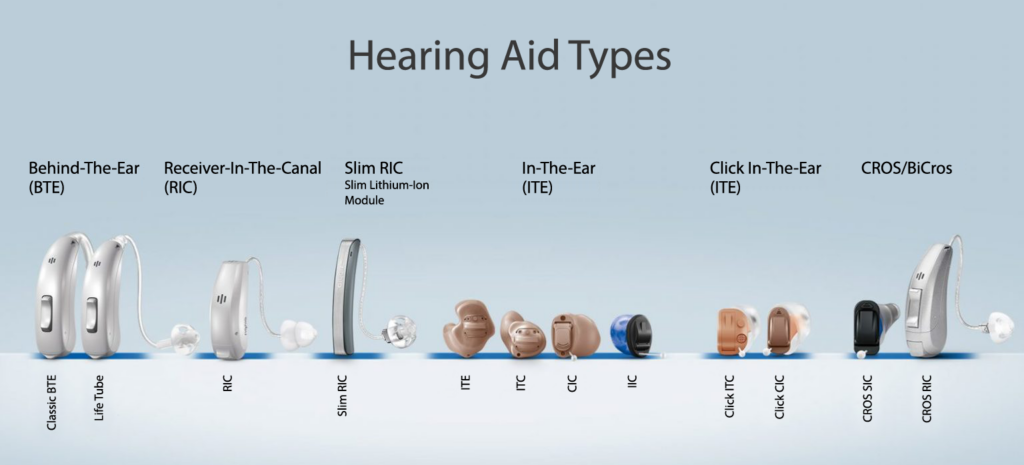
Hearing aids are commonly used to treat age-related hearing loss. In the U.S., hearing aids for mild to moderate hearing loss are even available over-the-counter. There are a number of different hearing aid types, each with different features and benefits. A qualified physician can assist you in determining the best type of hearing aid for you.
Our guide to caring for hearing aids
Taking care of your hearing aids is important. Be sure to review the instruction manual that came with your hearing aids for brand-specific maintenance details. For general cleaning and care, we’ve created a free, easy-to-follow guide you can download below. Keep it handy—whether on your phone, tablet, or printed out near where you store your hearing aids.
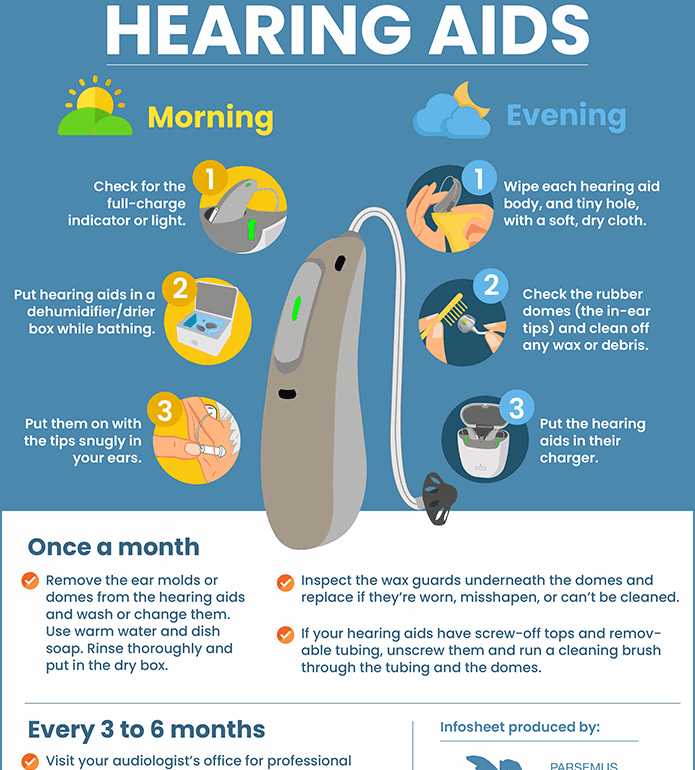
Click on the image to view and download the guide
Take action on
hearing and dementia
If you feel that you may have hearing loss, check out the information from the National Institute of Deafness and Other Communication Disorders on what steps you can take to diagnose and treat hearing loss.
For information on over-the-counter hearing aids available in the U.S., the FDA website has information and Consumer Reports evaluates several brands.

Frequently Asked Questions:
hearing and dementia
Hearing Loss Basics
Q: What are the early signs of age-related hearing loss (Presbycusis)?
A: Signs often include:
- Difficulty hearing high-pitched sounds (like women’s or children’s voices).
- Feeling like people are “mumbling.”
- Struggling to follow conversations in noisy environments (like restaurants).
- Needing to turn the TV volume up to a level that bothers others.
- Tinnitus (ringing or buzzing in the ears).
The Connection Between Hearing and the Brain
Q: How is hearing loss related to dementia?
A: Research shows a strong link between the two. Hearing loss is associated with approximately 8% of global dementia cases, making it the largest modifiable risk factor for dementia in midlife. When you can’t hear well, your brain must work much harder to decode sounds, which leaves fewer resources for memory and thinking. Hearing loss can also lead to social isolation and faster brain atrophy, both of which increase dementia risk.
Q: Does hearing loss cause dementia, or is it a symptom?
A: It is a bit of both. While hearing loss can lead to cognitive decline due to brain “disuse”, neurodegenerative diseases like Alzheimer’s can also damage the parts of the brain that process sound. This means that a decline in “central hearing” (how the brain understands sound) can sometimes be an early warning sign of dementia itself.
Q: Is “Peripheral” hearing the same as “Central” hearing?
A: No. Peripheral hearing is about the health of your physical ear—how well it picks up soft tones. Central hearing is about the brain—how well it interprets those signals into meaningful language. Standard hearing tests often only check peripheral hearing, but your ability to understand speech in a crowded room is a measure of your central hearing and brain health.
Hearing Aids for Hearing Loss
Q: Can wearing hearing aids actually prevent Alzheimer’s or dementia?
A: While they may not “cure” or “prevent” the disease entirely, a 2023 meta-analysis found that using hearing aids was associated with a 19% decrease in the risk of long-term cognitive decline. Furthermore, the landmark ACHIEVE study found that, among older adults at higher risk of cognitive decline, using hearing aids for 3 years reduced the rate of that decline by nearly 50%.
Q: Why don’t more people use hearing aids if they protect the brain?
A: Common barriers include high costs, social stigma, and the “adjustment period” required for the brain to get used to new sounds. Additionally, hearing loss is gradual, so many people don’t realize how much they are missing until their cognitive health is already affected.
Q: Are Over-the-Counter (OTC) hearing aids as good as prescription ones?
A: OTC hearing aids are a great, affordable option for adults with mild to moderate hearing loss. However, if your hearing loss is severe or complex, a prescription hearing aid fitted by an audiologist is recommended. The Parsemus Foundation provides resources for evaluating OTC brands through the FDA and Consumer Reports.
Q: How do I care for my hearing aids to make sure they last?
A: Proper maintenance is key to clear sound and longevity. This includes keeping them dry, cleaning out earwax regularly, and changing filters as needed. The Parsemus Foundation offers a free, downloadable Hearing Aid Maintenance Guide on their project page to help users keep their devices in top shape.
Last updated on October 14, 2026