Picture neutering a stray cat without any surgery, stitches, or recovery cage. That’s the promise behind a new approach called magnetic nanoparticle hyperthermia, or MNH. Two recent studies offer the most detailed look yet at this non-surgical neutering technique. One followed rats for nearly a year; the other tested the method in cats for the first time. Together, they help answer whether it works and whether it’s safe.
Injecting magnetic particles, then switching on a magnetic field
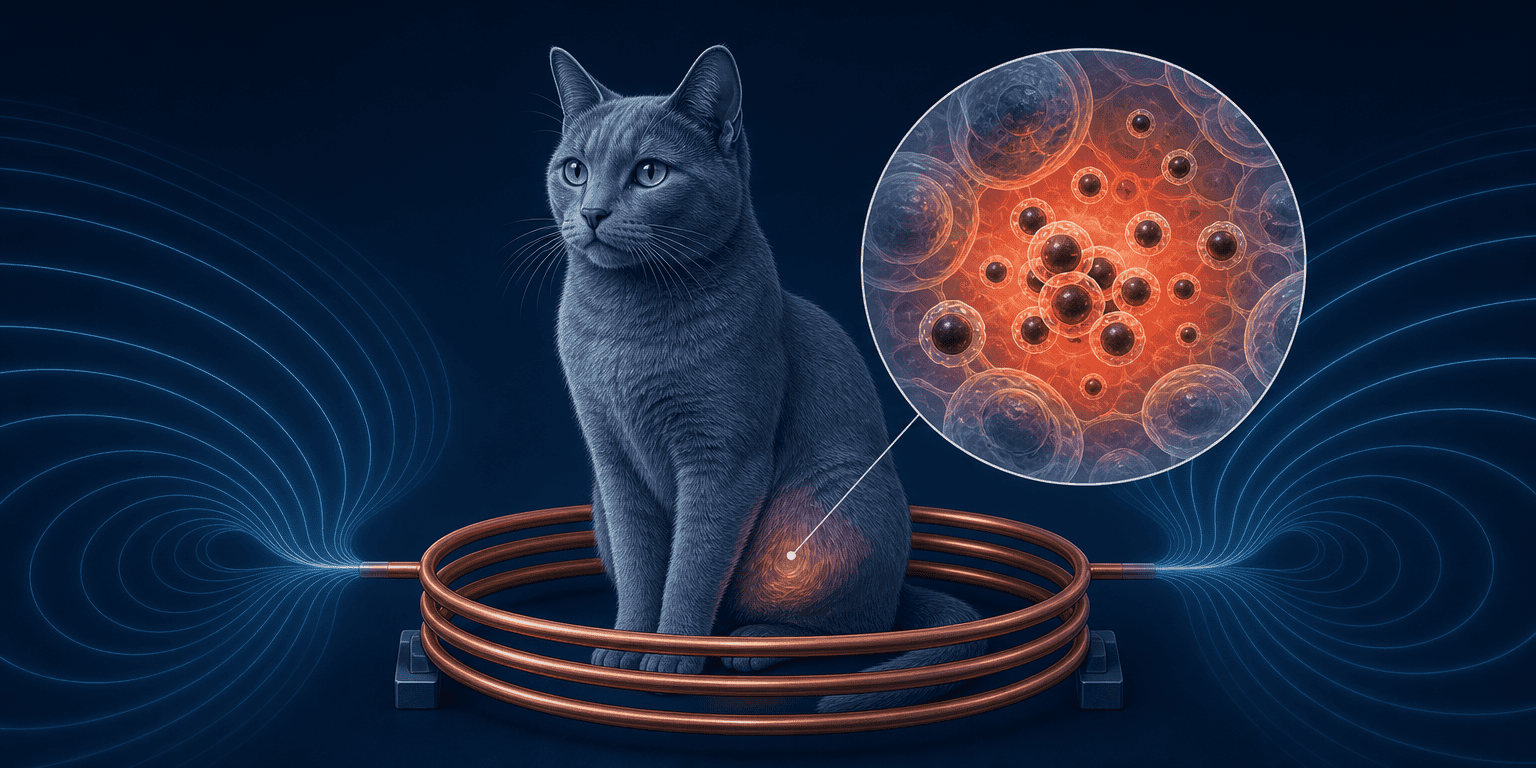
The core technique behind MNH is straightforward: inject tiny magnetic particles directly into an animal’s testicles, then apply an alternating magnetic field from a nearby coil. The particles heat up, raising testicular temperature to about 45°C (113°F) for roughly 15 minutes. The idea is that this internal heat damages the tissue that makes sperm, without harming anything else.
Before testing the approach in cats, the same Brazilian research group first piloted it in rats. This let them gauge how it might work. In that study, researchers tracked 16 Wistar rats for 345 days — nearly a full year. Eleven rats received the nanoparticle treatment; five received a saline injection as a control. The team checked blood work, hormone levels, and organ health monthly, then examined tissue under a microscope at the end.
The treatment worked with striking permanence in the rats. Testosterone dropped sharply within 30 days and stayed low. By six months, only 2 of 11 treated rats still had any detectable testosterone. By the end of the study, 9 of 11 animals had no identifiable testicles left. The tissue had simply atrophied away. The two rats with remaining tissue produced no sperm, and their gonads had stopped functioning. The treatment sterilized them.
Fertility dropped in both species, but testosterone told two different stories
Because the rat results were so promising, the team then studied the species of real interest: domestic cats. They treated 20 male cats and split them into two groups. One group was neutered surgically at 7, 24, or 47 days after treatment, to capture short-term effects. The other group waited 90, 145, or 180 days to test longer-term outcomes. Researchers tracked pain, testicle size, hormone levels, and organ function throughout.
In cats, the results told a similar story for fertility, but a different one for hormones. Testicular volume actually grew briefly in the first week, due to local inflammation, then shrank steadily. By 180 days, treated cats had significantly smaller and lighter testicles than untreated controls. Sperm counts collapsed. 85% of treated cats had no sperm at all (azoospermia), and the remaining 15% had very low counts (oligospermia). It’s unlikely the cats would have been fertile with such low sperm counts, though breeding tests were not conducted to confirm.
Testosterone, though, barely budged in cats. Unlike the rats, cat testosterone levels stayed within the normal range throughout the study. The paper’s authors compare this to cryptorchidism, a condition where undescended testicles impair fertility without eliminating hormone production. Study co-author Carolina M. Lucci, PhD, of the University of Brasilia, offered a related anatomical explanation in an interview with the Parsemus Foundation. “I believe there may be a difference between the species, as cat testicles are located much closer to the body than those of rats,” Lucci said. “Therefore, cat cells might possess greater resistance to high temperatures.”
Safety findings were reassuring in both species. Blood counts, liver and kidney markers, and organ imaging stayed normal throughout. In rats, researchers could not detect any magnetic nanoparticles in the body after a year. The body appears to clear them over time. In cats, pain scores were low and briefly elevated, and 4 of 20 animals developed small skin lesions that healed within two weeks without treatment.
Why the cat results weren’t perfect — and why that might not matter
It’s worth noting these are small studies — 16 rats and 20 cats — which limits how confidently the results generalize.
The cat results also weren’t perfect. Nanoparticles didn’t spread evenly through the testicular tissue in every animal. This likely happened because cat testicles are larger and denser than rat testicles. That uneven spread explains why 15% of cats still had some sperm at the end. The researchers suggest a larger injection volume might improve consistency in future work.
There’s also an interesting tradeoff buried in the cat data. Lucci sees it as a potential upside, not just a limitation. Because testosterone stays normal, treated cats may keep territorial and sexual behaviors even after becoming infertile. Cats living in colonies maintain hierarchical social relationships, Lucci explained. So preserving normal testosterone in sterilized males may help prevent the “vacuum effect.” That’s a situation where fertile males are removed, and other cats migrate in to occupy the vacated space. They then breed with the females who remain.
Even so, Lucci is cautious about calling this a proven benefit. “Further investigation and method refinement are still needed,” she said. She added that her team may still be able to close the gap with rats. “Perhaps, with a few adjustments, we can succeed in reducing testosterone levels and causing the testicles to disappear in cats, just as occurred with the rats.”
“Testicular MNH is a non-surgical method that allows animals to be released immediately after the procedure, without the need for postoperative care — making it highly suitable for TNR [trap, neuter, release] programs.”
— Carolina Lucci, PhD
Professor, University of Brasília

Where this leaves non-surgical neutering
Together, these two studies show that MNH can produce durable infertility with a single injection and no surgery. This held true in both a lab rodent and a cat. The rat data show the effect can last close to a year without harming general health. The cat data show it’s technically feasible and well tolerated — and additional research may fine-tune the procedure to ensure infertility.
Lucci confirmed that TNR (trap, neuter, release) programs for cats were the goal from the start. “We initiated the research with precisely that purpose in mind,” she said. “Testicular MNH is a non-surgical method that allows animals to be released immediately after the procedure, without the need for postoperative care — making it highly suitable for TNR programs.” She pointed to the elimination of post-op care as the method’s biggest practical advantage. There’s no cleaning surgical wounds, no medication schedule, no Elizabethan collars, and no operating room or sterile instruments.
“I believe the logistics would be simpler and costs lower,” she said. She noted, though, that the magnetic field equipment itself is currently expensive. That cost would need to spread across many procedures over time. Her team is already working on a cheaper alternative: “We are developing a new method that uses much cheaper equipment, developed by ourselves,” Lucci said. “We have already tested it on rats and cats, and the results are encouraging. We will probably publish these results in a few months.”
Real-world use is still a way off, though. Lucci said her team needs to monitor treated cats over longer periods to rule out delayed side effects. Regulatory agencies will also need to approve the method before it can be used in the field. She also mentioned an ongoing effort to make the equipment portable, so it could be brought directly to where colony cats live. That would avoid transporting the animals to a treatment center. As a strategy for controlling stray and feral animal populations without surgical infrastructure, this approach looks especially promising. Lucci’s team is actively working to close the remaining gaps.
DEEPER DIVE
Beyond neutering: magnetic hyperthermia is being explored for much more
Testicular neutering is just one narrow application of a much broader technology. Magnetic nanoparticle hyperthermia research has expanded into several other major human and animal health applications. Researchers can tune the same particles and magnetic fields to do very different jobs. It depends on how much heat they use. Turned up high, the heat can trigger cell death in diseased tissue outright. That’s useful for killing off a tumor, for instance. Turned down low, it can gently warm cells just enough to flip a switch inside them, without damaging anything. Researchers are using both ends of that range, and everything in between, to tackle a range of health problems.
One active area targets antibiotic-resistant infections. Bacteria often build a protective, slimy biofilm on implants or wounds that blocks antibiotics from working. Nanoparticle-generated heat can disrupt that biofilm directly, letting standard antibiotics reach and kill the bacteria.
Another line of research uses ultra-low, precise warming rather than damage. Specialized nanoparticles can bind to heat-sensitive channels on specific nerve cells. A magnetic field then gently opens those channels, turning nerve signals on or off. Researchers have already used this approach as a wireless alternative to implanted deep-brain stimulation hardware. By gently heating nanoparticles in a brain region tied to motor control, they restored normal movement in Parkinson’s-like mice. A related version of the same switch targets nerve endings in an arthritic joint instead of the brain. It has eased chronic pain and slowed joint damage in mice with osteoarthritis.
Researchers are also testing heat-triggered drug delivery. They pack drugs into magnetic nanoparticle carriers that travel through the body intact. Once they reach a target — a tumor or infection — a magnetic field warms the carrier enough to break it open. This releases the drug precisely where it’s needed.
In regenerative medicine, mild nanoparticle-generated heat can act as a gentle trigger rather than a destructive force. In one study, researchers used magnetic nanoparticles to raise bone tissue to 41–42°C. That was enough to prompt bone-forming cells to mature faster. It also switched on a gene that spurs new blood vessel growth at the injury site. Together, these effects accelerated bone repair without damaging surrounding tissue.
Seen against this backdrop, the neutering studies aren’t an isolated curiosity. They’re one branch of a fast-growing field that treats magnetic heat as a precision tool, not a blunt instrument.
See our other news articles about non-surgical sterilization in pets.